


Site Tour with Test Users
Choose a test user to login and take a site tour.
Choose a test user to login and take a site tour.


8 minutes, 15 seconds
-198 Views 0 Comments 0 Likes 0 Reviews
Every competitive player in MLB The Show 26 knows the absolute nightmare of facing a top-tier pitcher online. You are sitting on a 4-seam fastball, your eyes track a blur out of the hand, you drop your Plate Coverage Indicator (PCI) to the bottom of the screen, and you flail wildly at a sweeping slider that ends up in the opposite batter's box.
If you are tired of free-swinging at everything in your zip code, you need to treat plate discipline like a science. Improving your strike zone recognition isn't about having superhuman reflexes; it’s about setting up your visual environment, learning how to track specific "tunnels," and executing a structured game plan.
Here is exactly how to train your eyes to tear up opposing pitching in MLB The Show 26.
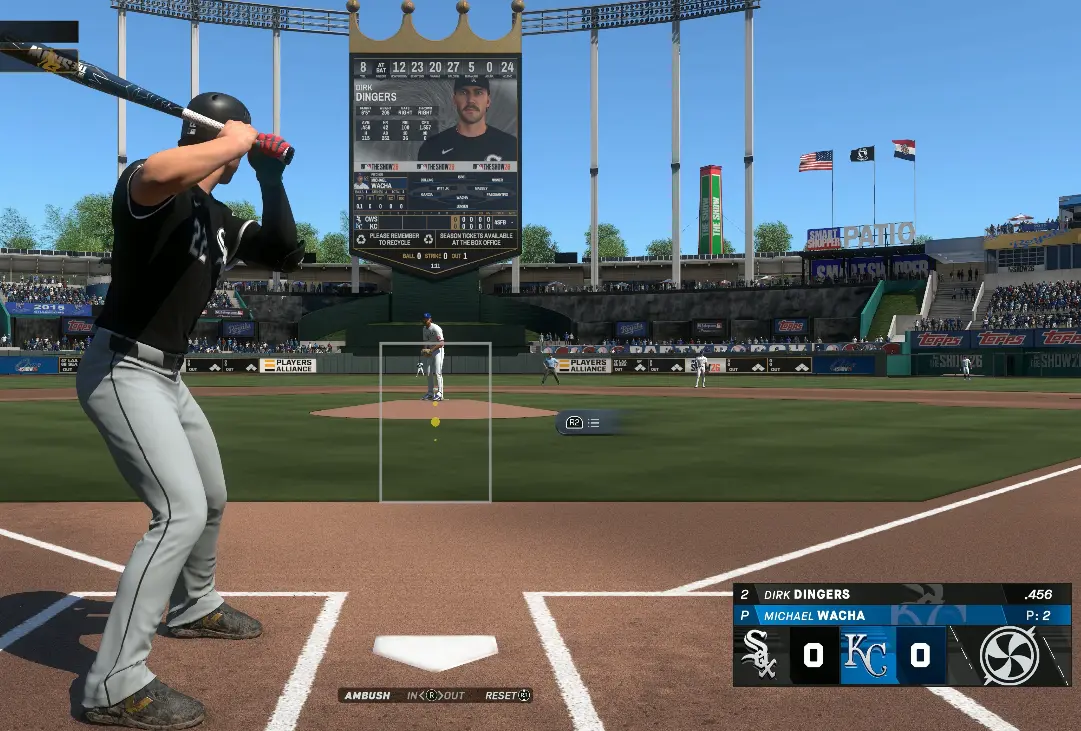
Before you even step into a Diamond Dynasty or Ranked Seasons game, you have to look at your settings. If you are playing on the default camera angle, you are actively handicapping your pitch recognition.
The Camera View: Switch your hitting view to Strike Zone or Strike Zone High. These angles eliminate the batter’s body model and stadium background clutter, placing your eyes directly at the level of the plate. It magnifies the ball, making it exponentially easier to read the spin and break.
Hitting Depth of Field: This is a crucial new feature in MLB The Show 26. Make sure this setting is turned ON. It adds a subtle blur to the background elements behind the pitcher, isolating the pitcher's release point and allowing your eyes to lock onto the ball immediately.
If you track the baseball only after it travels halfway to the plate, you are already too late. On All-Star or Hall of Fame difficulties, a 100 mph outlier fastball reaches the plate in roughly 400 milliseconds. The human brain requires nearly 200 milliseconds just to process the visual and signal your thumb to swing. That leaves you a literal blink of an eye to decide.
Instead of staring broadly at the pitcher's body, zero your focus down to a tiny window right next to their shoulder where the ball is released. During the first inning, take the first 3 to 4 pitches without swinging at all. Do not touch the controller stick. Just watch the ball leave the hand.
Good pitchers try to make two different pitches look identical for the first 15 to 20 feet of their flight. This is called pitch tunneling.
The Setup: Imagine a tight "tunnel" running from the pitcher's release point straight to the inside corner of the plate.
The Break: A 4-seam fastball will stay perfectly straight inside this tunnel. A hard slider will start in that exact same tunnel but snap hard away into the dirt or outside corner.
The Rule: Tell yourself before the pitch: "I am looking inside. If the ball deviates or pops up out of that tunnel early, I am taking it." By narrowing your focus to one spatial tunnel, you instantly filter out the "junk" pitches designed to make you chase.
The golden rule of MLB The Show 26 hitting is simple: Sit fastball first. It is significantly easier to start your swing logic on a high-velocity pitch and slow down your hands for a changeup than it is to get caught guessing offspeed and get completely blown away by 102 mph up and in.
To maximize your competitive edge in Diamond Dynasty, managing your in-game assets is just as important as managing your at-bats. Building a lineup packed with elite high-contact and high-vision hitters gives you larger PCI sizes, widening your margin for error on close pitches. If you need a quick boost to land those top-tier player cards from the Marketplace without spending hundreds of hours grinding offline Showdowns, head over to U4N to pick up some cheap MLB 26 stubs safely and quickly to round out your squad.
If you find yourself down 0-2 or 1-2 in every count, it’s because you are swinging at the pitcher's pitches. To fix this, implement a strict "take until two strikes" rule on your first few batters of a game.
Look at how the numbers work in your favor when you push counts deeper:
| Pitcher Stamina / Confidence | Hitting Window & Pitch Accuracy |
| High (1st - 3rd Inning) | Tiny Perfect Accuracy Region (PAR), pitches paint corners perfectly. |
| Low (Pitch Count 80+) | PAR expands drastically, pitches float over the heart of the plate ("meatballs"). |
By making an opponent throw 15 to 20 pitches per inning rather than 6 or 7, you drag down their pitcher's stamina. As their stamina drops, the break on their slider flattens out, and their fastball loses velocity. Suddenly, that unhittable pitcher is serving up easy-to-recognize cookies right over the middle of the plate.
The absolute biggest obstacle to clean strike zone recognition is "PCI slamming." This is the bad habit of panicking when a pitch is thrown low, causing you to violently slam your left analog stick all the way to the bottom gate, resulting in a popped-up ball or a completely missed swing.
Use the PCI Anchor: Set your PCI Anchor to Free. Before the pitch, anchor your indicator slightly high or slightly inside depending on the pitcher's tendencies. If an opponent loves high heat, anchoring high means your thumb doesn't have to move at all to hit it.
Wiggle the Stick: Keep your left thumb lightly moving or wiggling the stick right up until the windup. Keeping your thumb active prevents it from locking up, which leads to much softer, controlled micro-adjustments instead of wild, erratic jerks.
Put these mechanical adjustments together with a patient mindset, and you'll transform from a free-swinging liability into an absolute terror at the plate.


Share this page with your family and friends.