


Site Tour with Test Users
Choose a test user to login and take a site tour.
Choose a test user to login and take a site tour.


6 minutes, 17 seconds
-78 Views 0 Comments 0 Likes 0 Reviews
Most mountains give you one top. Lobuche gives you two, and they could not be more different. One welcomes determined beginners with ropes and crampons. The other turns away all but the most skilled mountaineers. They sit side by side above the Khumbu Glacier, sharing a name but almost nothing else. That split personality is exactly what makes Lobuche Peak Climbing such a fascinating choice in the Everest region.
Lobuche East stands at 6,119 meters and holds official trekking peak status, which keeps permits affordable and the climb achievable for fit first-timers. Lobuche West rises slightly higher at 6,145 meters but demands a full expedition permit, serious rock and ice skills, and a much bigger budget. A jagged, dangerous ridge connects the two, and very few teams ever attempt the traverse. Almost every guided trip aims for Lobuche East, and it still delivers genuine mountaineering from start to finish.
A full Lobuche Peak trip usually takes 16 to 19 days from Kathmandu, including flights, trekking, acclimatization, training, and the summit push. The total walking distance is roughly 130 kilometers round trip from Lukla. The summit of Lobuche East sits at 6,119 meters, or 20,075 feet. You begin in Lukla at 2,840 meters, pass Namche Bazaar at 3,440 meters, and set up high camp near 5,400 meters. Most itineraries also include Everest Base Camp at 5,364 meters and Kala Patthar at 5,545 meters. Summit day typically takes eight to twelve hours from high camp and back.
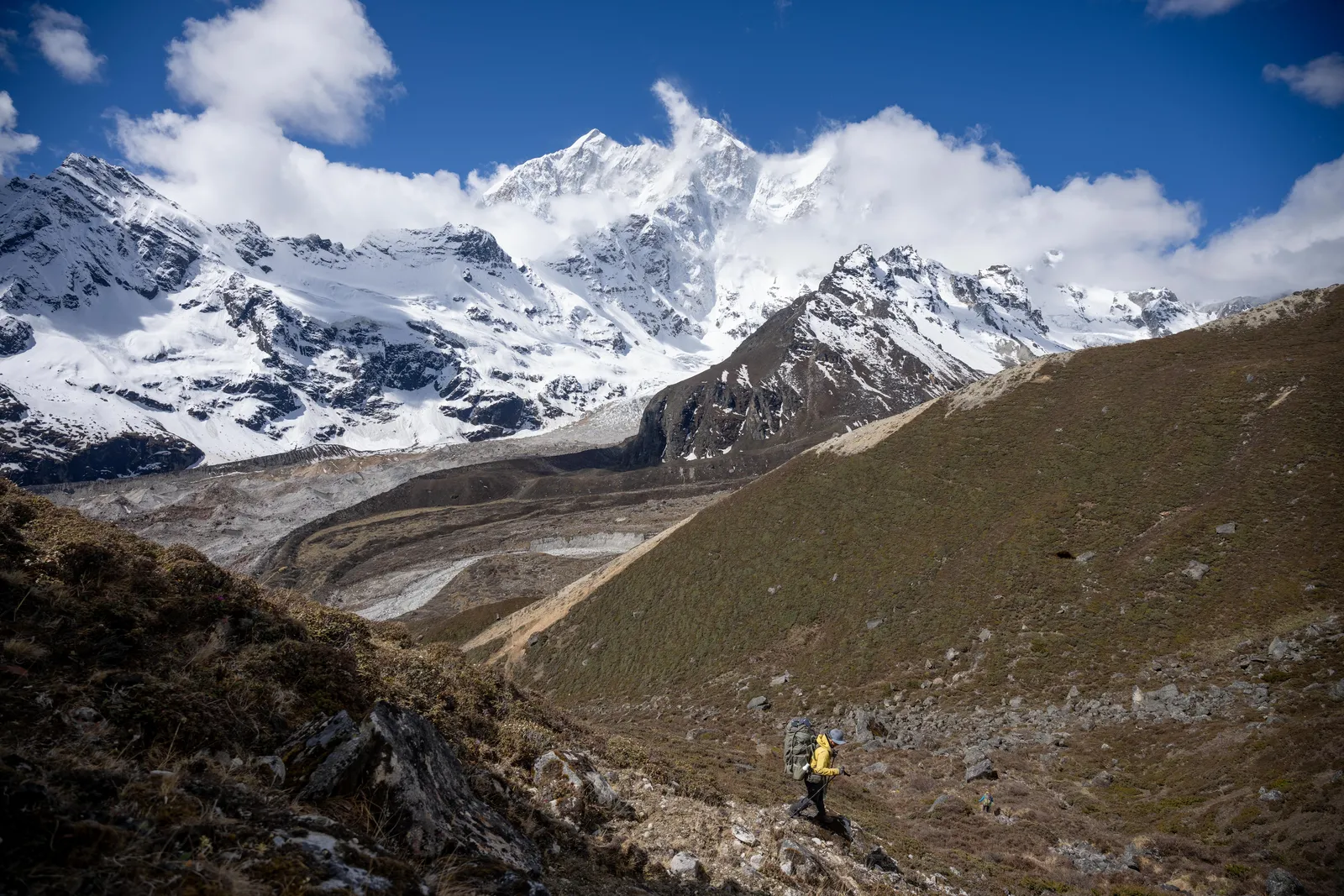
The approach is not filler. It is the reason so many climbers succeed here. You follow the classic Khumbu trail, crossing suspension bridges draped in prayer flags and resting in Namche Bazaar, the busy Sherpa trading town. Tengboche Monastery appears on day four, where monks chant at dawn beneath the towering shape of Ama Dablam. Each day adds a few hundred meters of elevation, letting your body quietly build the red blood cells it will need higher up. Most trips also visit Everest Base Camp and climb Kala Patthar before touching the mountain, so you arrive at high camp already well adjusted.
Summit morning starts around one or two in the dark, with headlamps bobbing across the glacier. The lower section is a steady snow walk, but the final stretch changes everything. A steep ice slope leads to a narrow, exposed summit ridge, and fixed ropes are used throughout. You will need to handle a jumar, trust your crampons on hard ice, and keep your nerve where the ground drops away on both sides. Good companies run a training day at base camp first, teaching rope work, crampon technique, and ice axe use. From the top, Everest, Lhotse, Nuptse, Makalu, and Cholatse surround you in a single, overwhelming sweep.
A strong team changes everything on a mountain like this. Nepal Social Treks and Expedition organizes guided Lobuche Peak climbs from Kathmandu. Their packages usually include climbing permits, Sagarmatha National Park fees, licensed climbing guides, group climbing gear, teahouse lodging on the trek, tented base camp and high camp with kitchen staff, all meals, and Lukla flights. Their guides run proper training sessions before the summit attempt and check each climber's health every morning. They also adjust the schedule when weather or altitude demands it, which is the single most important safety habit in the Himalayas. The company runs other trips too, including Island Peak, Mera Peak, Everest Base Camp, and Ama Dablam expeditions.
Spring, from March to May, brings warming days and stable snow conditions. Autumn, from late September to November, offers the clearest skies and sharpest views across the range. Winter buries the route under deep snow and savage wind, while monsoon brings cloud, rain, and constant Lukla flight delays. You do not need previous climbing experience for Lobuche East, but you do need strong hiking fitness and calm nerves. Train for at least three months with long hill walks carrying a loaded pack, and focus on endurance rather than raw speed.
Ask anyone who has stood on Lobuche East what stayed with them, and few mention the altitude figure. They talk about the cold silence at high camp, the rope stretching upward into the dark, and the moment the first light struck Everest while they balanced on that thin summit ridge. Two peaks share the name Lobuche, but only one lets ordinary people become genuine mountaineers. That is the triumph worth travelling for.



Share this page with your family and friends.