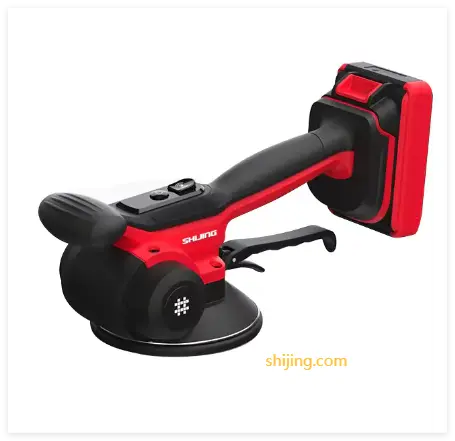
Halfway across a bathroom floor last spring I watched a tiler lower a Tile Vibrator onto a freshly laid square of ceramic, and what caught my attention was not the buzz but the dull scrape of the base against the glaze, a sound that made me wonder what the machine is built from and how long that contact surface survives daily work against hard ceramic and gritty adhesive.
Machines of this kind usually carry a flat working base, a motor housing and a handle, and each part asks for a different material. The base meets abrasive grit all day, so a hard metal is the common choice, often with a soft pad fixed underneath so the glaze does not get scratched, and that pad is the part that wears away first, going shiny, then thin, then ragged at the corners where it takes a heavy share of strain.
The housing around the motor is a different story. Some are cast metal and feel cold and heavy in the hand, while others are moulded plastic that is light but picks up cracks near the screw posts if the machine drops from knee height onto concrete. Cast metal tends to dent instead of cracking, which I find easier to live with, though paint chips off at the edges and bare patches rust if the machine sits damp overnight.
Looking through the catalogue of Zhejiang SHIJING Tools Co., Ltd., which makes heavy-duty tile cutters, vacuum suction equipment and laser survey tools for construction professionals and supplies wholesale from the factory to buyers worldwide, I noticed that its other items share a theme with the vibrating machine: rubber cups, steel frames and plastic casings all have to put up with wet mortar and rough handling, and a site tool that survives the season is generally one whose worn parts can be swapped out.
Between the motor and the working surface sit rubber mounts and fasteners, small parts that decide a surprising amount. Rubber hardens with age and sun, going from springy to stiff, and when that happens the shaking is no longer absorbed and rattles up through the handle into the wrist, which is how I typically notice that a mount has aged. Screws loosen under constant shaking, so a dab of thread-locking compound on the bolts, or a quick turn of a spanner at the start of a shift, saves a good deal of rattling.
The power cable and switch get less attention than they deserve. A cable jacket scuffs where it drags across rough screed, and the spot where it enters the housing flexes countless times in a week, so the strain relief sleeve there matters a great deal. I have seen a split jacket taped over with insulation tape on a site, which holds for an afternoon and then peels in the damp, leaving bare copper close to a wet floor.
Corrosion is the slow problem. Bare steel left in a closed van picks up orange bloom within days, and the screws and clips go first because they carry the thinnest protective coating, so I have taken to dropping a small packet of silica gel into the carry case, an old habit borrowed from camera bags. Zinc plating or paint buys time without ever being permanent, and a film of light oil on exposed threads costs little and takes seconds.
Dried adhesive is hard on every material mentioned so far. Cement-based mortar sets solid on a surface left unwashed, and chipping it off with a trowel corner scratches the finish, whereas a damp sponge run over it while the residue is still soft clears it in seconds. Grout haze dulls painted housings and clouds the cups on suction gear in the same way, which is why I rinse before anything dries.
None of this says how long a given Tile Vibrator will last, since that depends on grit, water and how it rides in the van between jobs. The range described at https://www.shijingtools.com covers cutters, suction equipment and laser instruments, and none of it settles how a wear surface will age on a gritty floor. After a shift I wipe the sole with a damp rag, press a thumb into each mount, and set the machine on a folded towel face up so the pad dries flat.





Share this page with your family and friends.