


Site Tour with Test Users
Choose a test user to login and take a site tour.
Choose a test user to login and take a site tour.


12 minutes, 12 seconds
-5 Views 0 Comments 0 Likes 0 Reviews
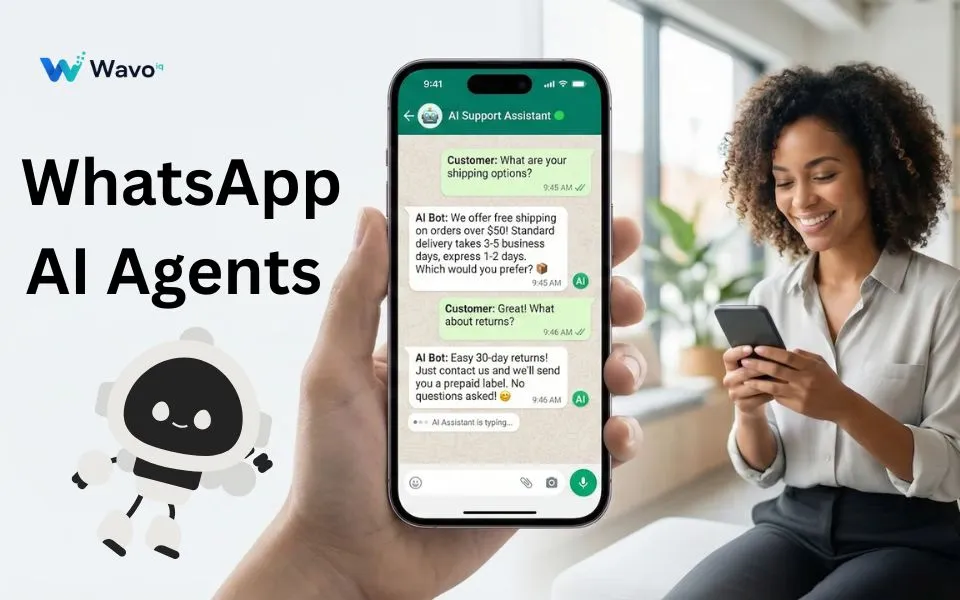
For many businesses, WhatsApp is one of the first places where a potential customer starts a conversation. Someone may ask about a product, request pricing, check availability, or simply send a quick “Hi.” The problem starts when the business receives more conversations than the sales team can handle.
A sales representative may not be able to respond immediately. Some leads may need several follow-ups before they share useful information. Others may not be serious buyers at all.
This is where WhatsApp AI Agents can help.
Instead of sending every new conversation directly to the sales team, an AI agent can start the conversation, understand what the person needs, ask relevant questions, and identify leads that are more likely to need human attention.
The goal is not to replace the sales team. It is to help the team spend more time on conversations that actually need them.
WhatsApp AI Agents are AI-powered systems that can communicate with customers through WhatsApp and handle parts of the conversation automatically.
Unlike a basic chatbot that mainly follows fixed buttons or predefined responses, an AI agent can understand the context of a conversation and respond based on what the customer says.
For example, imagine a person messages a real estate business:
“Hi, I’m looking for a 2-bedroom apartment in Mohali under ₹60 lakh.”
The AI agent can understand the property type, location, budget, and requirement. It can then ask a useful follow-up question such as:
“Are you looking for a ready-to-move property or an upcoming project?”
The conversation becomes more natural, while the business starts collecting information that can help the sales team.
Not every WhatsApp conversation is a sales-ready lead.
A business may receive messages from:
If sales representatives have to handle every conversation manually, they can spend a lot of time answering repetitive questions.
Lead qualification helps separate these conversations based on their needs and level of interest.
A qualified lead might have already shared important details such as:
This gives the sales team useful context before they step into the conversation.
The process does not need to be complicated. A typical conversation can follow a simple flow.
The customer may come from a website, social media campaign, advertisement, QR code, or WhatsApp link.
They send a message such as:
“I want to know about your courses.”
The AI agent responds immediately instead of making the person wait for a sales representative.
The next step is understanding what the person actually wants.
For example, the customer may be asking about:
The AI can use the conversation to understand the customer's intent instead of treating every message in the same way.
This is important because lead qualification is not just about collecting information. It is about understanding the conversation.
Once the AI understands the initial requirement, it can ask follow-up questions.
For example, an education business could ask:
AI: Which course are you interested in?
Lead: Data Analytics.
AI: Great. Are you looking for a weekday or weekend batch?
Lead: Weekend.
AI: Would you like to know the upcoming batch date and fee?
Each question is connected to the previous answer.
This makes the interaction feel more natural than showing a long form with ten questions at once.
The AI can capture useful details during the conversation.
Depending on the business, this might include:
The information can then be passed to the sales or CRM system.
Not every person who sends a message should immediately be treated as a hot lead.
The AI can use the information collected during the conversation to help identify different levels of interest.
For example:
Low intent:
“Just checking the price.”
Medium intent:
“I’m comparing two plans and want to know which one is better.”
High intent:
“I need this service next month. Can someone discuss the pricing and implementation with me?”
This type of qualification helps sales teams prioritize their time.
This is where the human sales team comes in.
Once a lead meets the business's qualification criteria, the AI can hand the conversation over to a salesperson.
Instead of the salesperson seeing only:
“Hi, I’m interested.”
They may receive something like:
Lead: Rahul
Requirement: Enterprise software plan
Company size: 50 employees
Budget: ₹2–3 lakh
Timeline: This month
Interest: Wants a product demo
The salesperson can now start with context.
There is no need to ask the same basic questions again.
A common misunderstanding is that using AI means removing humans from the sales process.
That does not have to be the case.
A better approach is to divide the work.
AI handles:
Sales team handles:
This creates a simple handoff between automation and people.
A lead may show interest but not be ready to speak with sales immediately.
For example:
“I’m interested, but I’ll check with my team and get back to you.”
Without follow-up, that conversation may disappear.
A WhatsApp AI Agent can help continue the conversation based on the business's follow-up process.
For example, after an appropriate period, it could ask:
“Hi Rahul, just checking in. Would you like to continue with the product discussion?”
The exact timing and message should depend on the business and customer context. The goal is to stay helpful rather than repeatedly sending promotional messages.
There is an important difference between an AI agent and a traditional rule-based chatbot.
A traditional chatbot might work like this:
Choose an option → Choose another option → Select a product → Submit details
It works well for simple and predictable processes.
An AI agent can handle more open-ended conversations.
For example:
“I’m not sure which plan I need. We have around 30 employees and mainly need automation for customer support.”
The AI can understand the request and ask questions based on the information already provided.
This makes the conversation more flexible.
AI works better when it has good business information to work with.
Before setting up a WhatsApp AI Agent, businesses should prepare:
The AI should also know when not to answer on its own.
For sensitive, complex, or unusual situations, handing the conversation to a human can be the better option.
The biggest value of WhatsApp AI Agents is not simply that they can reply quickly.
It is that they can help organize the early part of the sales journey.
Instead of sales representatives spending their day answering:
“What is the price?”
“What courses do you offer?”
“Where are you located?”
“Can you send the details?”
They can spend more time on conversations where the customer has already shown a clear need.
This can make the sales process more focused without removing the human side of selling.
WhatsApp AI Agents can help businesses move from simply answering WhatsApp messages to having more structured conversations with potential customers.
The AI can respond to new enquiries, understand intent, ask relevant questions, collect lead details, qualify conversations, follow up, and pass higher-intent leads to the sales team.
The important part is finding the right balance.
AI should handle repetitive and early-stage conversations, while people should step in when the conversation needs experience, judgment, negotiation, or a personal touch.
When this process is designed properly, WhatsApp becomes more than a messaging channel. It becomes a practical part of the lead qualification and sales process.
Contact Wavoiq and explore how AI-powered WhatsApp conversations can help your team respond, qualify, and follow up more efficiently.


Share this page with your family and friends.