


Site Tour with Test Users
Choose a test user to login and take a site tour.
Choose a test user to login and take a site tour.


10 minutes, 25 seconds
-291 Views 0 Comments 0 Likes 0 Reviews
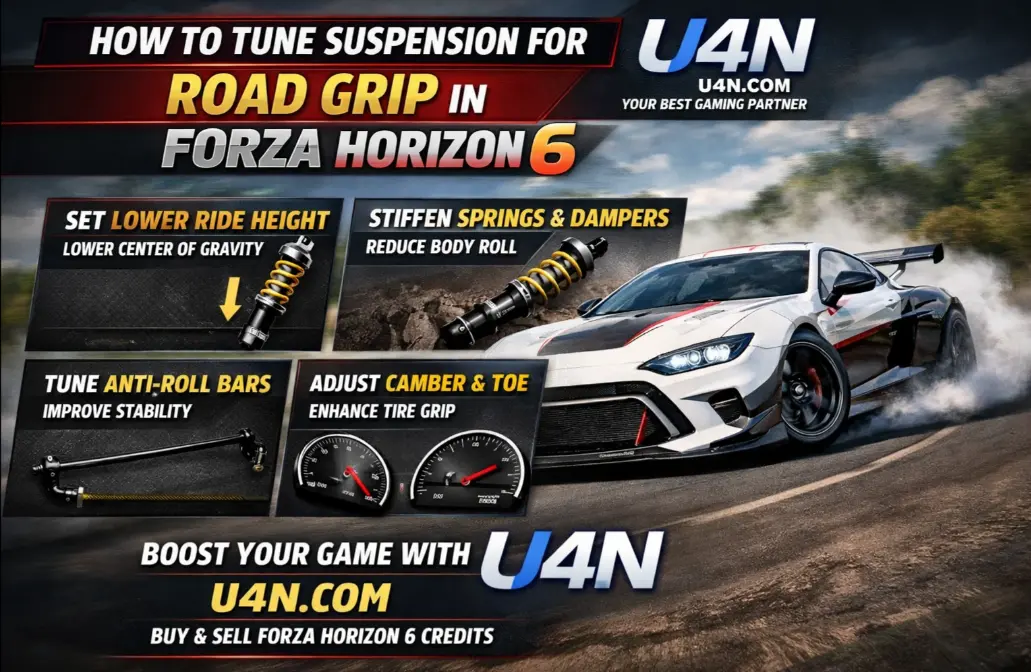
Many players upgrade power first in Forza Horizon 6, but real speed often comes from grip. Suspension tuning is one of the main tools that controls how your car actually uses its tires. If the suspension is wrong, even the fastest car will slide, bounce, or lose traction in corners.
This guide explains how experienced players approach suspension tuning for road grip. Instead of complicated theory, the focus is on the practical questions players usually ask while tuning their cars.
Suspension controls how weight moves around the car. When you brake, accelerate, or turn, the car’s weight shifts. Suspension settings determine how quickly and how smoothly that weight moves.
If the settings are too stiff, the tires lose contact with the road on bumps and uneven pavement. If the settings are too soft, the car rolls too much and becomes unstable during fast cornering.
Good suspension tuning helps the car:
Keep the tires in contact with the road
Control body roll in corners
Stay stable during braking and acceleration
Maintain grip through long turns
In practice, road racing in Horizon rewards cars that are stable and predictable rather than extremely stiff.
Before tuning anything, make sure the car actually has adjustable suspension.
Most players start with Sport or Race Suspension. Race suspension gives full control over:
Springs
Dampers
Ride height
Anti-roll bars
For serious tuning, race suspension is the better option because it lets you fine‑tune the car for specific road conditions.
Road racing in Horizon often includes bumps, elevation changes, and imperfect pavement, so suspension flexibility matters.
Spring stiffness affects how much the car compresses when weight shifts.
A common mistake is making springs too stiff because it feels “race-like.” In practice, overly stiff springs reduce grip on normal roads.
For road grip tuning:
Start slightly softer than the default race setup
Increase stiffness only if the car rolls too much
What players usually notice in testing:
If springs are too stiff:
The car bounces on bumps
Grip disappears in uneven corners
The car slides unexpectedly
If springs are too soft:
The car leans heavily in turns
Steering feels slow
Weight transfer becomes exaggerated
A balanced approach works best. For most road cars, a moderate spring setting allows the tires to stay planted while still controlling body movement.
Anti-roll bars control how much the car leans side-to-side in corners.
This is one of the easiest settings to feel while driving.
Front and rear bars affect handling balance differently.
Front anti-roll bar
Higher value = more understeer
Lower value = more front grip
Rear anti-roll bar
Higher value = more oversteer
Lower value = more rear stability
For road grip tuning, many players start with:
Slightly softer front bar
Slightly stiffer rear bar
This helps the car rotate into corners without becoming unstable.
Small adjustments are important here. Large changes can quickly make the car unpredictable.
Lower ride height usually improves handling because it lowers the car’s center of gravity. However, Horizon roads are not perfectly smooth.
If the car is too low, it may:
Bottom out on bumps
Lose grip over hills
Become unstable during high-speed compression
A good rule used by many experienced players:
Lower the car close to minimum, but leave a little extra height if the car is bouncing over bumps or curbs.
Cars used for sprint races on smoother roads can go lower. Cars used for longer road circuits may benefit from slightly higher ride height.
Damping controls how quickly the suspension moves.
This part of tuning can seem confusing, but in practice the effects are noticeable.
Rebound damping controls how fast the suspension extends after compression.
Higher rebound:
Reduces bouncing
Increases stability
Can make the car feel stiff
Lower rebound:
Allows more movement
Can improve grip on rough roads
Bump damping controls how the suspension reacts when hitting a bump or when weight shifts quickly.
Higher bump:
Makes the suspension resist compression
Helps control sharp weight transfer
Lower bump:
Allows the car to absorb bumps more easily
A common starting approach for road tuning:
Rebound slightly higher than bump
Both set to moderate values rather than extreme stiffness
If the car feels nervous over bumps, reduce damping slightly.
Instead of looking at numbers, experienced players pay attention to how the car behaves in three situations.
Corner entry
When braking into a turn, the car should feel stable and predictable. If the rear slides suddenly, the suspension may be too stiff or the rear anti-roll bar too high.
Mid-corner grip
During steady cornering, the car should feel planted. If it drifts wide, the front may be too stiff.
Corner exit
When accelerating out of a turn, the car should not bounce or suddenly lose traction. Excessive bouncing usually means springs or damping are too stiff.
Testing on the same road section repeatedly helps identify these problems quickly.
Yes. Different drivetrain layouts respond differently.
Front-wheel drive
Softer front suspension often helps grip
Too stiff front bars cause heavy understeer
Rear-wheel drive
Rear suspension stability is important
Too stiff rear bars can cause sudden oversteer
All-wheel drive
Generally more forgiving
Balanced suspension works best
Vehicle weight also matters. Heavier cars usually require slightly stiffer springs to control body movement.
Most players use a simple process.
First, pick a familiar road race route with a mix of:
Medium-speed corners
Braking zones
Slight bumps
Then change one setting at a time.
Driving a full lap after each change helps you clearly feel the difference.
Making several adjustments at once makes it difficult to understand which setting actually helped.
Some players use accounts that already contain rare cars or pre-built setups. Even then, suspension tuning is still useful because every player drives differently.
For example, players who obtain cars through services such as buy Forza Horizon 6 Modded Accounts ps5 often receive powerful vehicles with aggressive tunes. These setups may focus on speed rather than stability, so adjusting suspension for personal driving style can make the cars much easier to control during road races.
Even small changes to springs or anti-roll bars can significantly improve grip and consistency.
If you are unsure where to begin, start with small adjustments:
Springs: slightly softer than default race values
Front anti-roll bar: a little softer
Rear anti-roll bar: slightly stiffer
Ride height: low but not minimum
Rebound damping: moderate
Bump damping: slightly lower than rebound
This type of setup usually creates a balanced car that maintains grip on typical Horizon roads.
From there, you can fine-tune based on how the car behaves in corners.
Suspension tuning in Forza Horizon 6 is less about extreme settings and more about balance. Road racing rewards cars that stay planted over bumps and remain predictable through corners.
The best approach is simple:
Start with moderate settings
Make small changes
Test frequently on the road
Over time, you will begin to recognize how each suspension adjustment changes the way the car behaves. Once you reach that point, tuning becomes much faster and much more effective.


Share this page with your family and friends.