


Site Tour with Test Users
Choose a test user to login and take a site tour.
Choose a test user to login and take a site tour.


8 minutes, 57 seconds
-4 Views 0 Comments 0 Likes 0 Reviews
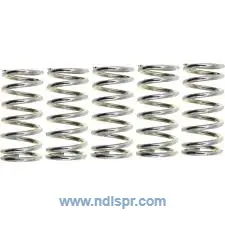
Choosing a spring by appearance alone can create problems once a component enters an actual assembly. A Precision Compression Spring needs to fit its available space, respond to the intended load, and work within the movement range defined by the surrounding mechanism. For engineers and purchasing teams, Ningdeli provides spring design and manufacturing support for applications where dimensional consistency and controlled force are important. So, what should be checked before deciding on the right spring size?
The first point is the installation space. A spring has to fit within the housing, guide structure, shaft arrangement, or mechanical cavity where it will operate. The outer diameter determines how much room the component occupies, while the inner diameter becomes important when a shaft or guide passes through the center. Free length also deserves attention because the spring must have enough room to compress without interfering with nearby parts.
It is useful to look at the working environment rather than treating dimensions as isolated figures. A component placed inside a compact electronic assembly may have strict space limitations, while a spring installed in industrial equipment may have greater room but face repeated mechanical movement. The same nominal size does not necessarily suit both situations. Installation clearance, surrounding components, operating direction, and available travel should be considered together.
Load is another central factor. Compression springs are generally selected according to the force required at particular working positions rather than simply according to their unloaded dimensions. Engineers may need to identify the initial load, working load, maximum expected load, and corresponding deflection. If a spring is too soft for the mechanism, it may not provide the intended resistance. If its characteristics are unsuitable for the assembly, excessive force can also affect connected components.
Spring rate connects force with deflection and therefore deserves careful attention during specification. Wire diameter, coil diameter, active coil count, material characteristics, and overall geometry all influence this behavior. Increasing one dimension does not automatically produce a suitable result because changes in geometry can affect several mechanical properties at once. A useful specification therefore describes how the spring should behave during operation, rather than relying on a single measurement.
Free length is usually easier to understand, but working length is just as important. Free length describes the spring before compression, whereas working length refers to its condition under an applied load. The difference between these positions represents deflection. When defining a spring for a real mechanism, it is often helpful to provide the expected load at a specific working position. This gives the manufacturer a clearer basis for developing the geometry.
End configuration should also be considered. The shape of the spring ends can affect how force is transferred into the surrounding parts and how the component sits on a supporting surface. Depending on the application, different end treatments may be appropriate. A design intended for a small instrument, a valve assembly, or an automated mechanism may have very different contact requirements even when the basic spring shape looks similar.
Material selection comes into the discussion when the operating environment is known. Temperature, corrosion exposure, repeated cycling, electrical requirements, and mechanical stress can all influence the material decision. Stainless steel is commonly considered for applications where corrosion resistance is important, while other spring materials may be selected according to strength, conductivity, fatigue behavior, or manufacturing requirements. Ningdeli states that its spring production covers applications including healthcare, aerospace, automotive, electronics, and new energy sectors, where material and dimensional requirements can vary significantly.
The expected number of operating cycles should not be overlooked. A spring used occasionally inside a hand-operated product faces a different workload from one that compresses and releases repeatedly inside automated equipment. Repeated stress can influence fatigue behavior, so the working range needs to be considered alongside material, geometry, surface condition, and manufacturing consistency. A spring specification based only on maximum force may leave important operating information unanswered.
Manufacturing tolerance is particularly relevant when several springs must work within the same product. Small differences in diameter, length, coil formation, or force response can influence assembly behavior when components are produced in volume. For that reason, buyers should communicate the required tolerances and inspection expectations before production begins. Ningdeli reports the use of high-precision spring machinery and automated inspection systems, with production covering fine wire sizes and custom spring requirements.
The most useful information to provide a spring manufacturer is therefore not limited to a drawing. A technical request can include available installation space, outer and inner diameter limits, free length, working length, required load points, expected movement, material preference, end configuration, environmental conditions, and estimated production quantity. If an existing component is being replaced, photographs, samples, drawings, or reference information can also help clarify the intended design.
For OEM projects, prototype development can be particularly helpful when the spring operates inside a new mechanism. A preliminary sample allows the engineering team to examine fit, movement, force response, and interaction with adjacent components before a production specification is finalized. This approach can reduce uncertainty during product development because the spring is assessed as part of the complete assembly rather than as an isolated piece of wire.
Size selection can also change when the available space is extremely limited. Compact electronic equipment, precision instruments, medical mechanisms, and small control assemblies may require a carefully balanced relationship between wire diameter, coil diameter, free length, and operating travel. Ningdeli's product range includes precision compression springs as well as other spring categories, allowing specifications to be considered according to the actual mechanical requirement rather than a generic shape.
For purchasing teams, communication with the manufacturer can be just as important as the initial dimensional drawing. Clear information about the intended application gives the technical team a practical starting point for discussing material, geometry, tolerances, production method, and inspection requirements. Ningdeli operates production bases in Zhejiang and Dongguan and states that it supports customers across automotive, electronics, healthcare, aerospace, new energy, and other fields, with capabilities for customized spring production.
When the application calls for a carefully matched spring, the specification should describe the actual working conditions instead of focusing on diameter or length alone. Engineers who define space, force, travel, material, tolerance, and operating cycles together give the manufacturer a clearer foundation for development. For projects requiring a Precision Compression Spring, product information and manufacturing support are available through Ningdeli at https://www.ndlspr.com/, where different application requirements can be discussed with the spring production team.



Share this page with your family and friends.