


Site Tour with Test Users
Choose a test user to login and take a site tour.
Choose a test user to login and take a site tour.


11 minutes, 52 seconds
-8 Views 0 Comments 0 Likes 0 Reviews
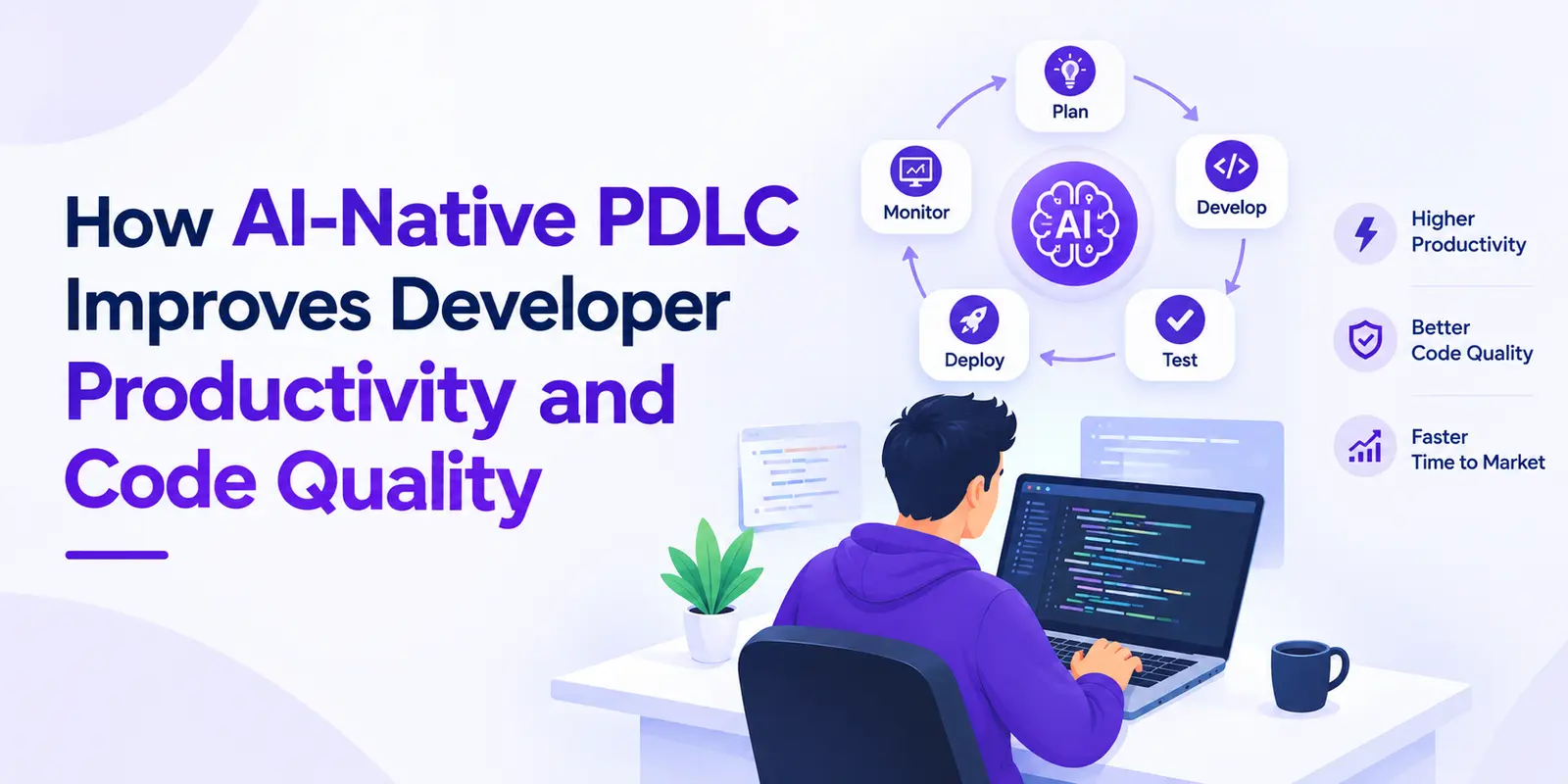
Software development is changing as artificial intelligence becomes part of everyday engineering work. Developers now use AI tools to generate code, explain complex logic, identify bugs, write tests, and improve existing applications. However, simply adding AI coding tools to a development team does not guarantee better results. Organizations also need a structured approach to integrate AI throughout the software development lifecycle.
This is where AI-native PDLC becomes valuable. It integrates AI into the Product Development Life Cycle, from planning and requirements analysis to implementation, testing, deployment, and maintenance. By combining AI capabilities with clear engineering practices, teams can improve developer productivity, maintain code quality, and deliver software more efficiently.
AI-native PDLC is an approach to software development in which AI is integrated into the core processes used to plan, build, test, release, and maintain software. Instead of treating AI as an occasional coding assistant, teams design their development processes around effective collaboration between developers, AI tools, and automated systems.
In traditional development workflows, developers manually complete many repetitive activities, including writing boilerplate code, creating test cases, documenting functions, and investigating common errors. AI can assist with these tasks, allowing engineers to focus more on architecture, complex problem-solving, and product decisions.
AI-native software development does not mean removing developers from the process. It means using AI to support engineering decisions while keeping people responsible for reviewing code, validating outputs, and ensuring that software meets business and technical requirements.
One of the most immediate benefits of an AI-native approach is reduced time spent on repetitive coding activities.
AI coding assistants can generate initial implementations, suggest code completions, create documentation, and help developers understand unfamiliar codebases. These capabilities reduce the effort required to complete routine tasks and make it easier to move from an idea to a working implementation.
For example, a developer building a REST API can use AI to draft endpoint handlers, suggest input validation, and generate initial unit tests. The developer can then review the implementation, correct any issues, and adapt the code to the project's architecture.
A structured AI Coding Workflow helps teams apply these capabilities consistently. Rather than using AI randomly, developers follow defined steps for planning, implementation, testing, and review.
The result is a more efficient development process in which engineers spend less time on repetitive work and more time solving meaningful technical problems.
Writing code faster is useful only when the resulting software works reliably. Code quality must remain a priority as AI-generated code becomes more common.
AI can help developers identify potential defects, suggest edge cases, generate unit tests, and explain errors. It can also support code reviews by highlighting duplicated logic, suspicious patterns, and possible security weaknesses.
For example, when implementing a payment feature, an AI tool may suggest tests for invalid inputs, failed transactions, unexpected responses, and boundary conditions. Developers can use these suggestions to improve test coverage before the code reaches production.
However, AI-generated tests and code reviews are not always complete or correct. Teams should combine AI assistance with automated test suites, static analysis, security scanning, and human review.
This combination helps organizations improve code reliability without depending entirely on AI-generated recommendations.
Debugging can consume a significant portion of a developer's working day, especially when issues involve unfamiliar frameworks, complex dependencies, or large codebases.
AI tools can accelerate troubleshooting by explaining error messages, identifying possible causes, suggesting debugging steps, and summarizing relevant code. Developers can also use AI to compare alternative solutions and understand the trade-offs between them.
Consider a situation where an application experiences unexpected API failures. An AI assistant may help trace the problem to incorrect request handling, missing validation, or a dependency issue. The engineer must still verify the explanation and confirm the actual root cause.
An effective AI-native process also encourages developers to document recurring issues and share validated solutions. This reduces repeated investigation and helps teams learn from previous development work.
By shortening investigation cycles, AI can help developers resolve problems more efficiently while maintaining control over technical decisions.
As AI capabilities advance, software engineering workflows are expanding beyond simple code suggestions. AI agents can assist with multi-step activities such as analyzing requirements, planning implementation tasks, modifying code, running tests, and preparing changes for review.
This approach is closely related to Agentic PDLC, where AI agents participate in different stages of product development within defined permissions and workflows.
For example, an AI agent may analyze a development task, propose an implementation plan, make changes in a controlled environment, and execute relevant tests. A developer can then inspect the results, review the changes, and approve the next step.
Clear boundaries are essential. Teams should define which actions AI agents can perform independently, which require human approval, and how changes are recorded.
With appropriate controls, developers can delegate routine activities while retaining responsibility for architecture, security, business logic, and final delivery.
When every developer uses AI differently, results can vary across a team. Some developers may review generated code carefully, while others may accept suggestions without sufficient testing. These differences can create inconsistent coding practices and increase maintenance risks.
A standardized AI coding workflow for engineering establishes guidelines for using AI throughout the development process.
A practical workflow may include:
Planning: Define requirements, acceptance criteria, and technical constraints.
Implementation: Use AI to explore solutions and generate code where appropriate.
Validation: Run tests, inspect edge cases, and verify AI-generated changes.
Review: Check readability, security, maintainability, and compliance with team standards.
Documentation: Record important decisions, test results, and changes for future reference.
Teams should also establish guidelines for sensitive data, repository access, approved tools, and AI-generated dependencies.
Savyre explores AI-assisted engineering workflows that help teams bring more structure and visibility to AI-supported software development. A well-defined process allows organizations to benefit from AI while maintaining consistent engineering standards.
Organizations need measurable evidence to determine whether AI adoption is improving software development.
Counting lines of code or measuring the number of AI-generated suggestions provides limited insight into engineering performance. Instead, teams should track outcomes that reflect delivery speed, reliability, and maintainability.
Useful measurements include:
Lead time for changes: How long it takes to move a code change from development to delivery.
Defect rate: How frequently defects are introduced into software.
Test effectiveness: Whether tests detect meaningful errors and cover important scenarios.
Change failure rate: How often releases cause problems requiring remediation.
Code review efficiency: How quickly teams identify and resolve issues.
Developer experience: Whether engineers spend less time on repetitive work and more time on complex tasks.
These metrics should be evaluated together. Faster implementation is not an improvement if it leads to more defects, security problems, or expensive rework.
Savyre supports the broader conversation around evaluating practical developer skills and making engineering performance more visible through structured assessment approaches.
Despite its advantages, adopting AI across the development lifecycle introduces several challenges. AI-generated code may contain bugs, misunderstand requirements, introduce security weaknesses, or rely on outdated assumptions. AI agents can also make mistakes when operating across complex development environments.
Organizations can address these risks by introducing AI gradually, defining clear review standards, and testing AI-generated changes before deployment. Teams should establish human approval points for high-impact decisions and ensure that sensitive information is handled appropriately.
Training is equally important. Developers need to understand how to write effective prompts, evaluate AI-generated output, identify hallucinations, and validate proposed solutions.
The goal is not to maximize AI usage at every stage. It is to identify where AI creates measurable value and integrate it into processes where quality, accountability, and efficiency can be maintained.
AI-native PDLC provides a structured way to improve developer productivity and code quality by integrating AI into planning, coding, testing, debugging, and delivery. It helps reduce repetitive work, accelerate problem-solving, strengthen testing practices, and create more consistent engineering workflows.
However, successful adoption depends on more than selecting AI tools. Organizations need clear processes, reliable quality checks, appropriate governance, and skilled developers who can validate AI-generated results.
When implemented thoughtfully, AI-native software development enables teams to work more efficiently without sacrificing reliability or maintainability.
Build a more structured approach to AI-assisted development with clear workflows, practical evaluation, and measurable engineering outcomes. Contact us today to explore how Savyre can support your technical assessment and AI-assisted engineering goals.


Share this page with your family and friends.