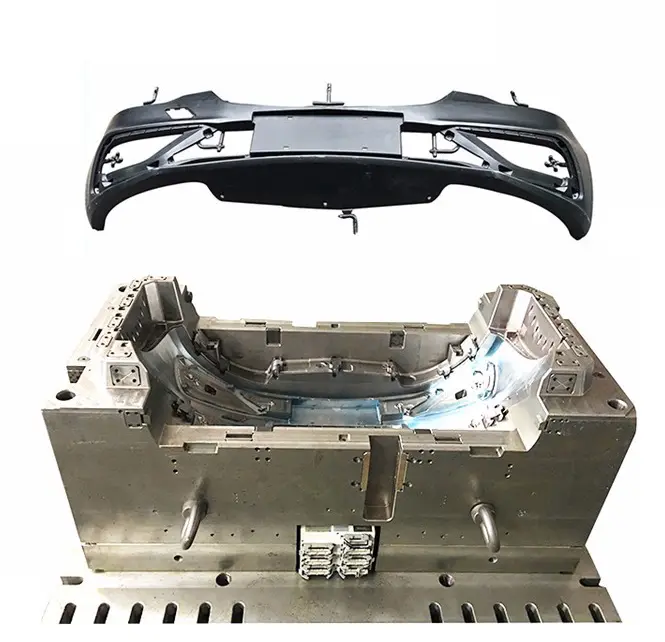
Modern automotive manufacturing increasingly relies on hot runner systems integrated into Bumper Mold designs to improve efficiency, reduce waste, and enhance part quality.
A hot runner system keeps molten plastic in a heated manifold and delivers it directly into mold cavities without forming solidified runners. This eliminates the need for regrinding and reduces material waste by up to 20–30%.
In a typical bumper mold setup, hot runner temperatures are maintained between 180°C and 260°C depending on material type. Cartridge heaters and thermocouples are used to ensure precise temperature control within ±1–2°C.
Valve gate systems are commonly used in bumper molding to control flow timing. This allows sequential filling of large bumper cavities, reducing weld lines and improving surface finish quality.
Injection systems using hot runners can operate under pressures ranging from 90 MPa to 150 MPa. This ensures complete cavity filling even in complex geometries such as fog lamp housings and grille integration areas.
One of the major advantages of hot runner systems in a Bumper Mold is cycle time reduction. By eliminating runner cooling, production cycles can be reduced by 10–25 seconds per shot, significantly increasing output in mass production environments.
However, hot runner systems require precise maintenance. Thermal imbalance or nozzle wear can lead to inconsistent filling or material degradation. Regular inspection and calibration are essential for stable production.
In conclusion, hot runner technology enhances both efficiency and part quality in automotive bumper production, making it an essential component of modern bumper mold engineering.





Share this page with your family and friends.