


Site Tour with Test Users
Choose a test user to login and take a site tour.
Choose a test user to login and take a site tour.


12 minutes, 33 seconds
-113 Views 0 Comments 0 Likes 0 Reviews
A customer sends your business a WhatsApp message.
It could be a simple “Hi,” a question about pricing, a product enquiry, or someone ready to buy.
What happens next?
If your team responds hours later, asks the same questions again, or forgets to follow up, that conversation can quietly turn into a lost sale.
This is where WhatsApp automation for business becomes more than just sending automatic replies. With AI, businesses can automate much of the sales journey—from the first message to lead qualification, follow-ups, appointment booking, and human handoff.
Instead of treating WhatsApp as another inbox, businesses can turn it into an active sales channel.
WhatsApp sales automation uses software, workflows, and AI to handle repetitive parts of the customer journey automatically.
An automated system can:
Modern AI-powered systems can go beyond fixed chatbot buttons. They can understand conversational questions, use business information to respond, evaluate buying intent, and decide when a human should take over. Wavoiq, for example, combines AI conversations, lead scoring, follow-ups, and human handoff within WhatsApp sales workflows.
The real value of automation becomes clearer when you look at the entire journey.
The journey starts when a prospect contacts your business.
They may come from a website, social media campaign, Click-to-WhatsApp ad, QR code, or an existing customer referral.
Without automation, the message sits in a shared or personal inbox until someone responds.
With AI-powered WhatsApp automation, the first response can happen immediately—even outside business hours.
For example:
Customer: “Hi, I’m interested in your marketing package. How much does it cost?”
AI: “Absolutely. We offer packages based on business size and requirements. How many locations does your business currently operate?”
The conversation has already moved beyond a generic “Thanks for contacting us.”
Not every WhatsApp enquiry is the same.
One person may want pricing. Another may need product recommendations. Someone else may simply be researching.
AI can understand the conversation and identify the customer's intent instead of treating every message identically.
This makes the experience more natural and helps businesses determine what action should happen next.
This is one of the most valuable parts of WhatsApp automation for business.
Instead of sending every enquiry directly to a salesperson, AI can ask relevant qualifying questions.
Depending on the business, these might include:
The AI can then categorize leads based on the information collected.
For example:
Cold lead: Just researching
Warm lead: Interested and comparing options
Hot lead: Has a clear requirement, budget, and timeline
This helps sales teams spend more time on conversations that are actually worth pursuing.
Many businesses lose leads not because the customer said no, but because nobody followed up.
A prospect might say:
“I’ll check with my team and get back to you.”
Then nothing happens.
AI automation can schedule an appropriate follow-up based on the conversation.
For example:
After 2 days: “Hi Rahul, just checking in. Were you able to review the package we discussed?”
If the customer responds, the conversation can continue.
If they say they are not interested, the workflow can stop.
The goal isn't to send endless messages. It is to make sure genuine prospects don't disappear simply because a salesperson forgot to follow up.
Customers often ask the same questions repeatedly.
“What is the price?”
“Do you offer a free trial?”
“How long does setup take?”
“Can I book a demo?”
“What is included?”
AI can answer these questions using approved business information.
It can also handle common objections before a salesperson becomes involved.
For example:
Customer: “Your price seems high.”
AI: “I understand. The package includes setup, automation, and ongoing support. Would you like me to show you what is included?”
This keeps the conversation moving while staying within the business's defined rules.
Automation shouldn't mean removing people from the sales process.
The best approach is knowing when AI should stop and a human should take over.
When a prospect shows strong buying intent, the system can alert a salesperson with relevant context.
Instead of receiving:
“New lead: Rahul”
the salesperson can receive:
“Rahul is interested in the premium package, has two locations, requested pricing, and wants a demo this week.”
That makes the handoff faster and more useful.
At this stage, the human salesperson can focus on what humans do best: building trust, handling complex requirements, negotiating where appropriate, and closing the deal.
The AI has already handled the repetitive work.
That means the sales representative doesn't need to start with:
“Hi, what are you looking for?”
They already know.
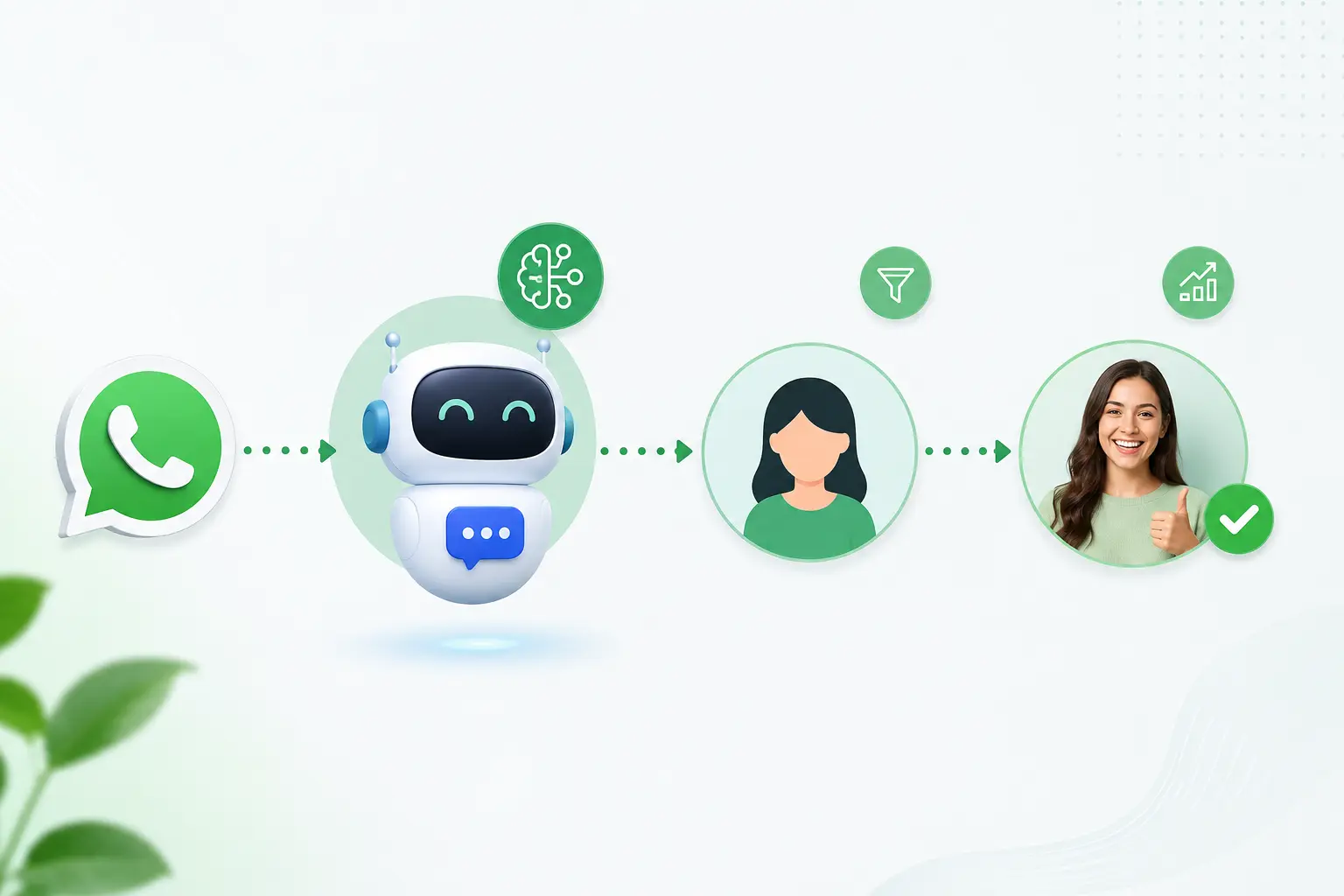
The complete journey can look like this:
WhatsApp Message → Instant AI Reply → Understand Intent → Qualify Lead → Answer Questions → Follow Up → Score Buying Intent → Human Handoff → Sales Conversation → Customer
This is the difference between using WhatsApp simply as a messaging channel and using it as a sales automation system.
Imagine a real estate company receives 100 WhatsApp enquiries every month.
Without automation, agents may spend hours answering basic questions about location, budget, property type, and availability.
With AI automation, the system can ask:
“Which location are you interested in?”
“What is your approximate budget?”
“Are you looking for a 2BHK or 3BHK?”
“When are you planning to purchase?”
The AI can organize the responses, identify serious buyers, share relevant information, and alert an agent when someone is ready for a site visit.
The same model can work for education, healthcare, D2C brands, agencies, financial services, and other businesses that receive frequent WhatsApp enquiries.
The biggest benefit isn't simply saving a few minutes per conversation.
It is creating a more consistent sales process.
With the right setup, businesses can:
Current WhatsApp automation platforms increasingly combine AI qualification, CRM integration, follow-ups, and sales routing rather than treating chatbot responses as a standalone feature.
Wavoiq is built for businesses that want to turn WhatsApp conversations into structured sales opportunities.
Its AI can respond to enquiries, understand conversations, qualify leads, score buying intent, manage follow-ups, and alert your sales team when human involvement is needed. It can also connect conversations with CRM and other business workflows.
The result is simple: your team spends less time managing repetitive WhatsApp conversations and more time closing qualified opportunities.
Want to turn your WhatsApp inbox into a smarter sales channel? Explore Wavoiq and see how AI-powered WhatsApp automation can fit your sales process.
Yes. When automation includes lead qualification, personalized conversations, follow-ups, and human handoff, WhatsApp can support the sales process from first enquiry through to a sales-ready conversation.
No. Small businesses can also benefit, particularly when they receive frequent enquiries but have limited sales staff. Automation can help them respond faster and maintain consistent follow-ups.
AI can automate repetitive parts of the sales journey, but human salespeople remain important for complex questions, relationship building, negotiation, and closing high-value deals.
A traditional chatbot usually follows predefined flows. AI sales automation can understand conversational intent, maintain context, qualify prospects, personalize responses, trigger follow-ups, and decide when a human should take over.
A WhatsApp message is not just a customer enquiry. It can be the beginning of a sales journey.
The businesses that benefit most from WhatsApp automation for business are those that connect every step: instant response, intelligent qualification, helpful conversations, timely follow-up, and a smooth human handoff.
The goal isn't to automate every interaction.
It's to automate the work that slows your sales team down—so your people can focus on turning the right conversations into customers.
From WhatsApp Message to Customer: How AI Can... 0 0 0 30 2
2 photos




Share this page with your family and friends.