


Site Tour with Test Users
Choose a test user to login and take a site tour.
Choose a test user to login and take a site tour.


10 minutes, 23 seconds
-15 Views 0 Comments 0 Likes 0 Reviews
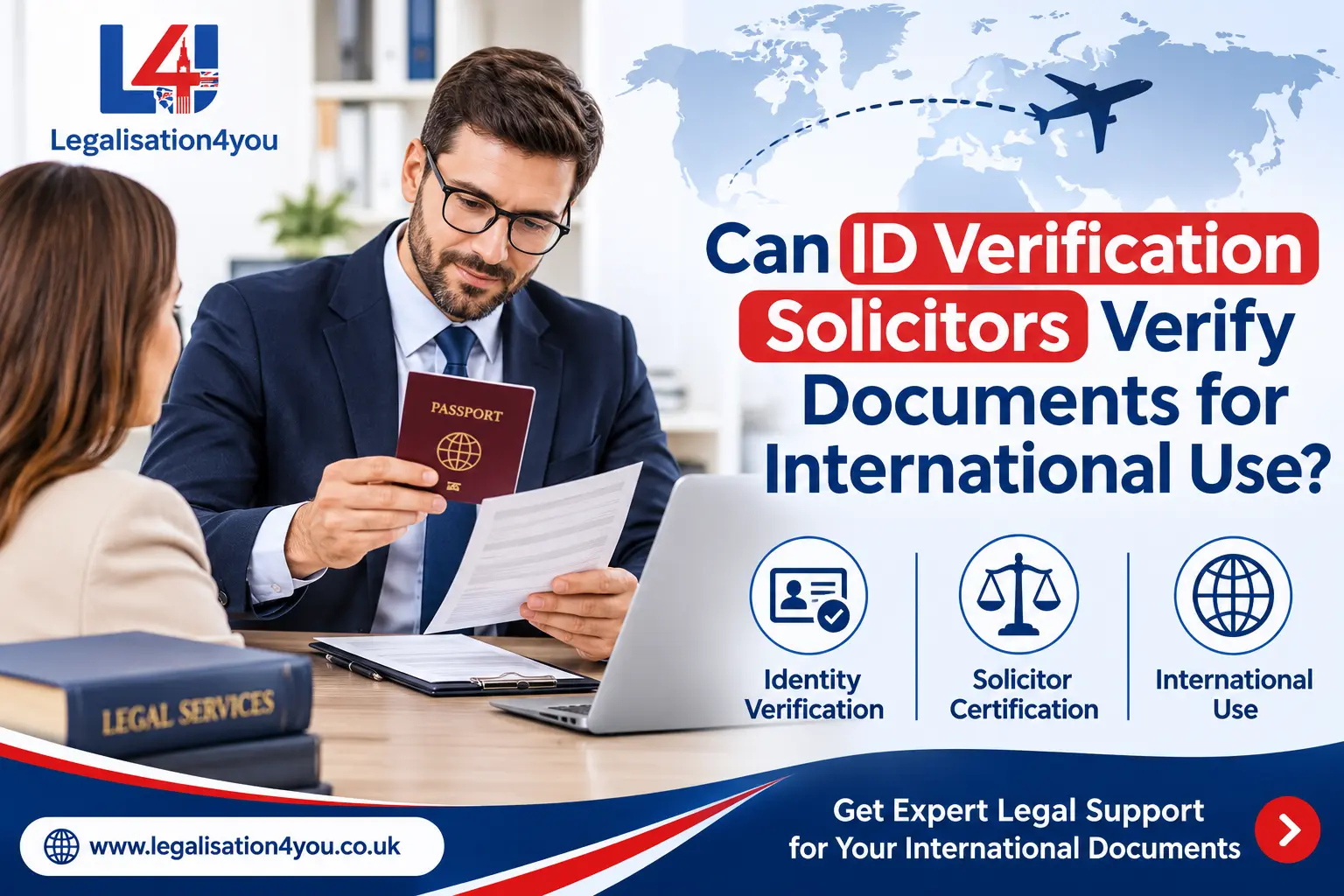
When preparing documents for use abroad, proving your identity is often an important part of the process. Banks, government departments, overseas authorities, educational institutions, and legal organisations may request verified copies of identity documents before accepting an application. This is where id verification solicitors can help by checking identification documents and, where appropriate, certifying copies or witnessing signatures.
However, identity verification and document legalisation are not the same thing. A solicitor may be able to confirm that a copy of an identity document is a true copy of the original, but this does not automatically mean that the document will be accepted by a foreign authority. Additional steps, such as notarisation, apostille certification, or embassy attestation, may be required.
Below are some frequently asked questions to help you understand how the process works.
Yes, solicitors can verify certain identity documents for international use, depending on the service requested and the receiving authority's requirements. They may check original identification documents and certify copies as true copies of the originals.
Common examples include passports, driving licences, and other recognised identity documents. However, the receiving organisation must confirm whether solicitor certification is acceptable.
For some international applications, further notarisation or legalisation may be necessary before the paperwork can be used abroad.
The documents that can be checked depend on the solicitor's service and the organisation requesting verification. Commonly requested identification documents include:
UK passports.
Driving licences.
National identity cards.
Proof of residential address.
Utility bills.
Bank statements.
Other official identification documents.
Some organisations may request more than one form of identification. It is always advisable to check the accepted document list before arranging an appointment.
Identity verification is commonly required when completing legal, financial, business, and international administrative procedures. Organisations need to establish that an applicant is who they claim to be.
For example, you may need verified identity documents when opening an overseas bank account, applying for international services, completing property transactions, or submitting documents to a foreign organisation.
Using id verification solicitors can help provide the requested confirmation when the receiving organisation accepts solicitor-certified identification.
No, these services are related but serve different purposes.
ID verification involves checking a person's identity using recognised identification documents. Document certification usually involves confirming that a copy of an original document is accurate.
For example, a solicitor may inspect an original passport and certify a photocopy as a true copy. This does not necessarily confirm the authenticity of every detail contained in the passport or replace any additional authentication required overseas.
Understanding the difference helps you arrange the correct service for your application.
Acceptance depends on the country, organisation, and purpose for which the documents are being submitted.
Some overseas organisations accept copies certified by a UK solicitor. Others may request certification by a notary public or additional legalisation through an apostille or embassy.
Before arranging verification, contact the receiving authority and ask which professionals are authorised to certify your documents. This can help prevent rejected applications and unnecessary processing delays.
In many cases, yes. When certifying a copy of an identity document, a solicitor will generally need to inspect the original document before confirming that the copy is accurate.
You should bring the original passport, driving licence, or other requested identification, along with the photocopies if required.
If the organisation has specific instructions about certification wording, signatures, dates, or stamps, provide these to the solicitor before the appointment.
A solicitor may certify certain documents or provide a signature that can be authenticated through the appropriate legalisation process. However, not every solicitor-certified document automatically qualifies for an apostille.
The Foreign, Commonwealth and Development Office (FCDO) issues UK apostilles to authenticate eligible signatures, stamps, or seals on documents. The document must meet the relevant requirements.
If an overseas authority requests an apostille, check whether the document needs solicitor certification, notarisation, or another form of preparation first.
Solicitors and notaries public are both legal professionals, but their responsibilities are different.
Solicitors provide legal services such as advice, document preparation, certification of copies where appropriate, and witnessing signatures.
Notaries public have specific authority to perform notarial acts, particularly for documents intended for use outside the UK. They can verify signatures, administer certain declarations, and prepare or authenticate documents for international purposes.
When dealing with overseas paperwork, the receiving authority may specifically request notarisation rather than ordinary solicitor certification.
The time required depends on the type of document, the verification requested, and the service provider's availability.
Straightforward identity checks or copy certifications may be completed during an appointment. However, additional steps such as notarisation, apostille certification, certified translation, or embassy legalisation can increase the overall processing time.
It is best to arrange verification early, particularly if you have an international application deadline.
Some service providers offer remote identity verification, but availability depends on the type of verification and the organisation requesting it.
Online checks may involve uploading identification documents, providing personal details, or completing a video identification process. However, remote verification may not be accepted when an original document must be inspected or a physical signature needs to be witnessed.
Always confirm whether the receiving organisation accepts online verification before choosing this option.
Yes, solicitors may provide certified copies of identity documents for overseas applications, provided the requested certification falls within their professional services.
The certification may include a statement confirming that the copy is a true copy of the original, together with the solicitor's signature, name, date, and professional details.
However, requirements differ between countries. Some authorities may request a notary-certified copy or an apostille instead.
Before attending an appointment, prepare all the documents requested by the receiving organisation. These may include:
Your original passport or driving licence.
Recent proof of residential address.
Photocopies of the documents requiring certification.
Application forms or verification instructions.
Any additional identification requested by the organisation.
Providing the correct paperwork can help the solicitor complete the verification process without unnecessary delays.
Verified identity documents may be accepted internationally, but there is no single certification process that applies to every country.
Some countries accept solicitor-certified copies, while others require notarisation, apostille certification, or embassy legalisation. The purpose of the document also affects the requirements.
For this reason, applicants should always confirm the specific rules with the relevant overseas authority before submitting their paperwork.
Preparing documents for international use can involve several steps, particularly when identity verification, notarisation, and legalisation are required. Choosing the correct process from the beginning can help reduce application problems and avoid unnecessary delays.
Legalisation4you provides guidance and assistance with UK document legalisation services, including apostille certification, notary services, and embassy attestation. Whether you are preparing personal, educational, or business documents for overseas use, understanding the receiving country's requirements is an important first step.
Visit to explore available services and get assistance with preparing your documents for international use.


Share this page with your family and friends.