


Site Tour with Test Users
Choose a test user to login and take a site tour.
Choose a test user to login and take a site tour.


17 minutes, 19 seconds
-20 Views 0 Comments 0 Likes 0 Reviews
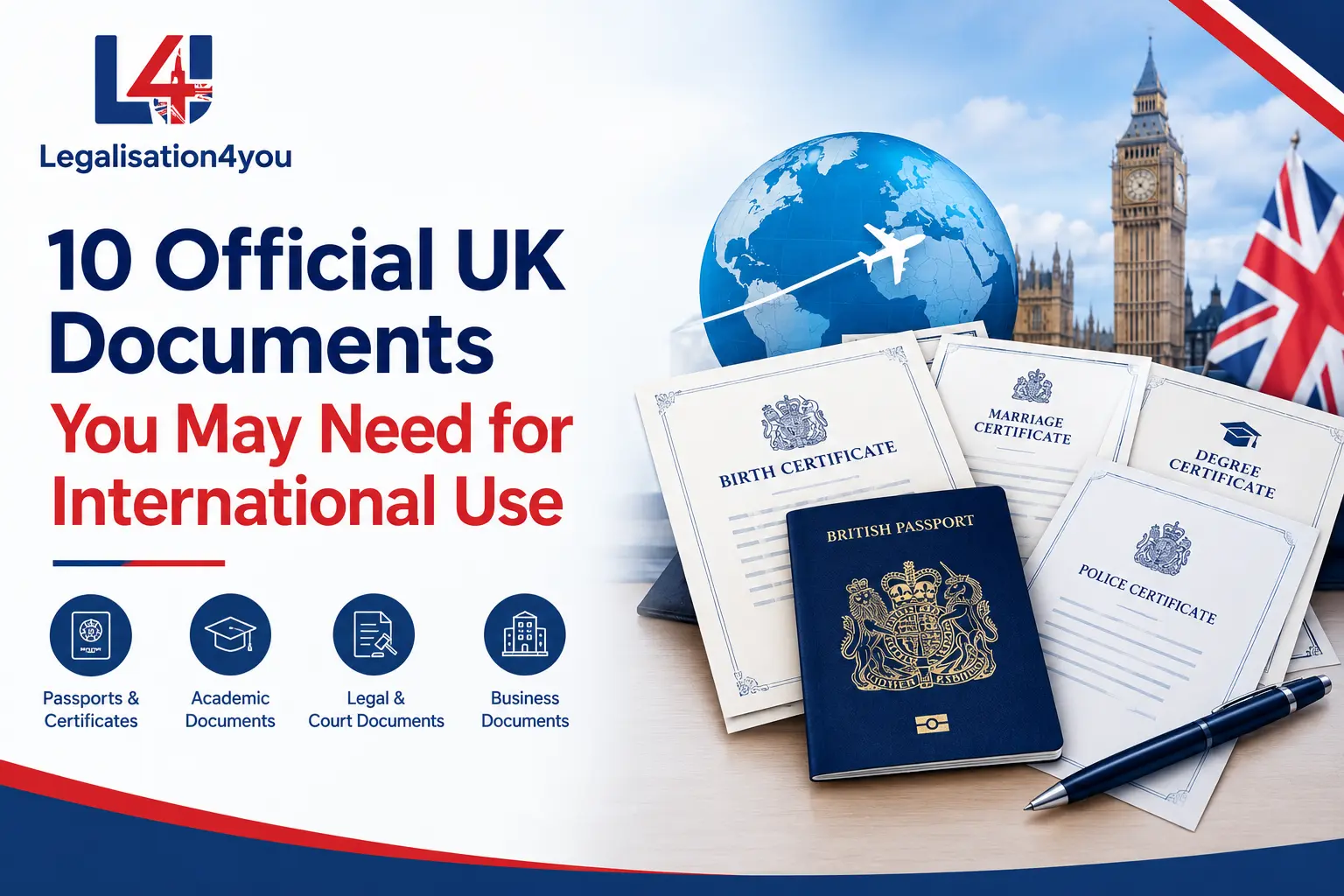
When you plan to work, study, marry, relocate, do business or handle legal matters abroad, you may be asked to provide documents issued in the UK. However, simply having the original document may not always be enough. Depending on the destination country and the organisation requesting it, your paperwork may need certification, notarisation, an apostille, legalisation or translation.
The process can sometimes feel complicated because different documents have different requirements. GOV.UK explains that certain UK documents can be legalised by the Legalisation Office, which checks signatures, stamps or seals and, where appropriate, attaches an apostille.
Using an official UK documents service can help you understand the steps involved and prepare your paperwork correctly before it is submitted.
Below are 10 common types of UK documents that you may need when dealing with international authorities.
A UK birth certificate is one of the most commonly requested documents for international purposes. It can be needed when applying for residency, citizenship, family visas, overseas marriage registration or other official procedures.
For example, an authority abroad may want proof of your identity, date of birth or parentage. In these circumstances, you may need to provide an official certificate rather than a simple photocopy.
Depending on the destination, the birth certificate may need an apostille or another form of legalisation. GOV.UK specifically lists birth certificates among documents issued by public registries that can be eligible for legalisation.
If the receiving authority requires the document in another language, you may also need a suitable translation.
Marriage certificates can be important when moving abroad with a spouse, applying for family residency, registering a marriage overseas or dealing with property and inheritance matters.
An overseas authority may ask for evidence that your marriage is legally registered in the UK. You may therefore need an official copy of your marriage certificate.
In some cases, the document may need to be legalised before it is accepted abroad. GOV.UK advises applicants to check with the person or authority requesting the document to determine whether legalisation is necessary.
You should also check whether a translated version is required if the destination country's official language is different from English.
Death certificates can be required for international inheritance, estate administration, insurance claims, pension matters and other legal procedures.
For example, if a deceased person owned property or financial assets overseas, local authorities may request evidence of the death before allowing certain processes to continue.
A UK death certificate may therefore need to be supplied to a foreign authority. Depending on the country and purpose, you may need legalisation or an apostille.
It is important to establish the requirements before sending the certificate abroad, particularly if it forms part of a wider legal or financial application.
Students and professionals frequently need UK educational documents when moving overseas.
These may include:
An overseas university, employer, professional regulator or government department may ask for evidence of your qualifications.
Some qualification certificates can be legalised if they have been appropriately certified by a UK public official, such as a notary or solicitor. GOV.UK gives qualification certificates as an example of documents that may require certification before legalisation.
Because educational documents can have different requirements, check whether the receiving organisation needs the original, a certified copy or a particular form of authentication.
Police certificates and criminal record documents may be required when applying for overseas employment, immigration, residency or certain professional positions.
The requirements can vary according to the country and organisation requesting the certificate. You may also need to obtain the document from the appropriate UK authority before arranging any additional certification or legalisation.
It is particularly important to check the type of police certificate required because not every criminal record document follows the same process.
GOV.UK includes police and criminal records among the categories of documents relevant to British people dealing with official procedures abroad.
One important point is that certain UK police and criminal record documents are not eligible for an e-Apostille. GOV.UK currently lists ACRO police certificates and DBS certificates among documents that cannot receive an e-Apostille.
A power of attorney allows one person to give another person authority to act on their behalf in specified circumstances.
These documents can be particularly important when dealing with overseas property, banking, business transactions or legal matters.
If a UK power of attorney is going to be used in another country, the receiving authority may require it to be notarised and then legalised.
GOV.UK confirms that documents such as powers of attorney can be legalised when they have been appropriately certified by a UK public official.
The exact process can depend on the destination country, so it is advisable to establish the requirements before signing or notarising the document.
Divorce-related documents may be required when someone is remarrying overseas, dealing with immigration matters, resolving property issues or providing evidence of marital status.
You may also need court orders, judgments or other legal documents for international proceedings.
Court-issued documents can sometimes be eligible for legalisation. GOV.UK explains that certain court documents bearing an appropriate wet-ink court seal can be submitted for legalisation.
If the document is being used in a foreign legal system, you should check whether the receiving authority requires additional certification, translation or embassy legalisation after the UK apostille stage.
Medical documents may be needed internationally for employment, immigration, insurance, education or other official purposes.
Examples include:
The document may need to be signed or certified by an appropriate professional before it can be legalised.
GOV.UK specifically notes that certain medical certificates signed by a registered doctor can be eligible for legalisation.
Because medical documents can contain sensitive and technical information, accuracy is particularly important if translation is required.
Businesses operating internationally may need UK corporate documents for overseas transactions, registrations, contracts, banking or expansion.
Common examples include:
A foreign authority or business partner may request proof that a UK company exists and is properly registered.
GOV.UK identifies company certificates issued by Companies House as examples of documents that can be eligible for legalisation.
Depending on the destination, corporate paperwork may also need notarisation, certification, apostille, embassy attestation or translation.
Affidavits and statutory declarations can be required for a wide range of international legal and administrative purposes.
For example, you may need to make a declaration concerning your identity, marital status, address, business activities or another legal matter.
A notary may be required to witness or authenticate certain documents before they are submitted for legalisation. GOV.UK explains that notaries can authenticate legal documents and that authorities in other countries sometimes request notarised documents for matters such as marriage, banking and property transactions.
The correct procedure should always be confirmed with the authority requesting the document.
No. Not every UK document automatically needs an apostille.
An apostille is generally required when the receiving authority specifically asks for a legalised UK document. GOV.UK advises applicants to check with the person or organisation requesting the paperwork before applying.
There are also different apostille options. The UK currently provides both paper-based apostilles and e-Apostilles, although not every type of document qualifies for the electronic option.
For this reason, it is better to establish the document route first rather than automatically ordering an apostille.
Certification and legalisation are related but different steps.
Certification can involve a UK notary or solicitor confirming a document or copy meets the required conditions.
Legalisation is the process through which the UK Legalisation Office verifies an eligible signature, stamp or seal and attaches an apostille.
Some documents can be submitted directly because they already carry an acceptable signature or seal. Others may need certification before legalisation.
The correct route depends on the document and its intended use.
Every country can have its own requirements for accepting foreign documents.
For Hague Convention countries, an apostille may be the relevant form of legalisation. For countries outside the Hague Convention, additional steps may apply. GOV.UK explains that documents intended for non-Hague countries can involve UK Legalisation Office processing followed by embassy and local Ministry of Foreign Affairs procedures.
This is why you should not assume that the same process works for every destination.
Before starting, find out:
Having these answers can make the process considerably easier.
Managing several stages yourself can be time-consuming, especially if you have multiple documents or a tight deadline.
An official UK documents service may assist with document preparation, certification, notarisation, apostille and legalisation requirements, depending on the service provider and your specific needs.
A professional service can also help you identify potential issues before your documents are submitted. This is particularly useful when documents need to be used for overseas employment, marriage, education, immigration, business or legal matters.
However, you should always confirm the final requirements with the organisation or authority receiving your documents.
Preparing UK documents for international use does not have to be confusing. From certificates and academic records to legal documents, powers of attorney and business paperwork, the correct process depends on the document and destination.
If you need help understanding certification, apostille, notarisation or legalisation requirements, Legalisation4you can assist with document-related services for international use.
Visit to learn more about the available services and discuss your document requirements before starting the process.
Official UK documents are documents issued or certified by recognised UK authorities, public bodies, professionals or institutions. Examples include birth certificates, marriage certificates, court documents, company certificates and academic qualifications.
No. An apostille is only needed when the receiving authority or destination country requires legalisation. GOV.UK recommends checking with the organisation requesting the document before applying.
Yes, eligible UK birth certificates can be submitted for legalisation. GOV.UK lists birth certificates issued by public registries among documents that can be legalised.
Yes. UK degree certificates, diplomas and other qualifications may be required for overseas employment, education or professional purposes. Depending on the destination, additional certification or legalisation may be required.
They may. The requirement depends on the organisation and country where the document will be used. Some overseas authorities require a power of attorney to be notarised before it can be legalised.
An e-Apostille is an electronic form of apostille issued by the UK Legalisation Office. It can be downloaded and shared digitally, but it is not available for every document type.
Generally, no. GOV.UK states that documents issued outside the UK cannot be legalised through the UK Legalisation Office and should instead be legalised in the country where they were issued.
It depends on the destination authority. If the receiving organisation does not accept English documents, you may need a certified translation. Always check the specific requirements before arranging translation.
Processing time depends on the service selected and the document. GOV.UK currently states that standard paper-based legalisation can take up to 25 working days, while e-Apostille applications can take up to 2 working days, subject to circumstances and document eligibility.
A professional official UK documents service can help you understand and arrange relevant document services, depending on your requirements. You should also check the instructions provided by the overseas authority receiving your paperwork before proceeding.


Share this page with your family and friends.