


Site Tour with Test Users
Choose a test user to login and take a site tour.
Choose a test user to login and take a site tour.


12 minutes, 1 second
-17 Views 0 Comments 0 Likes 0 Reviews
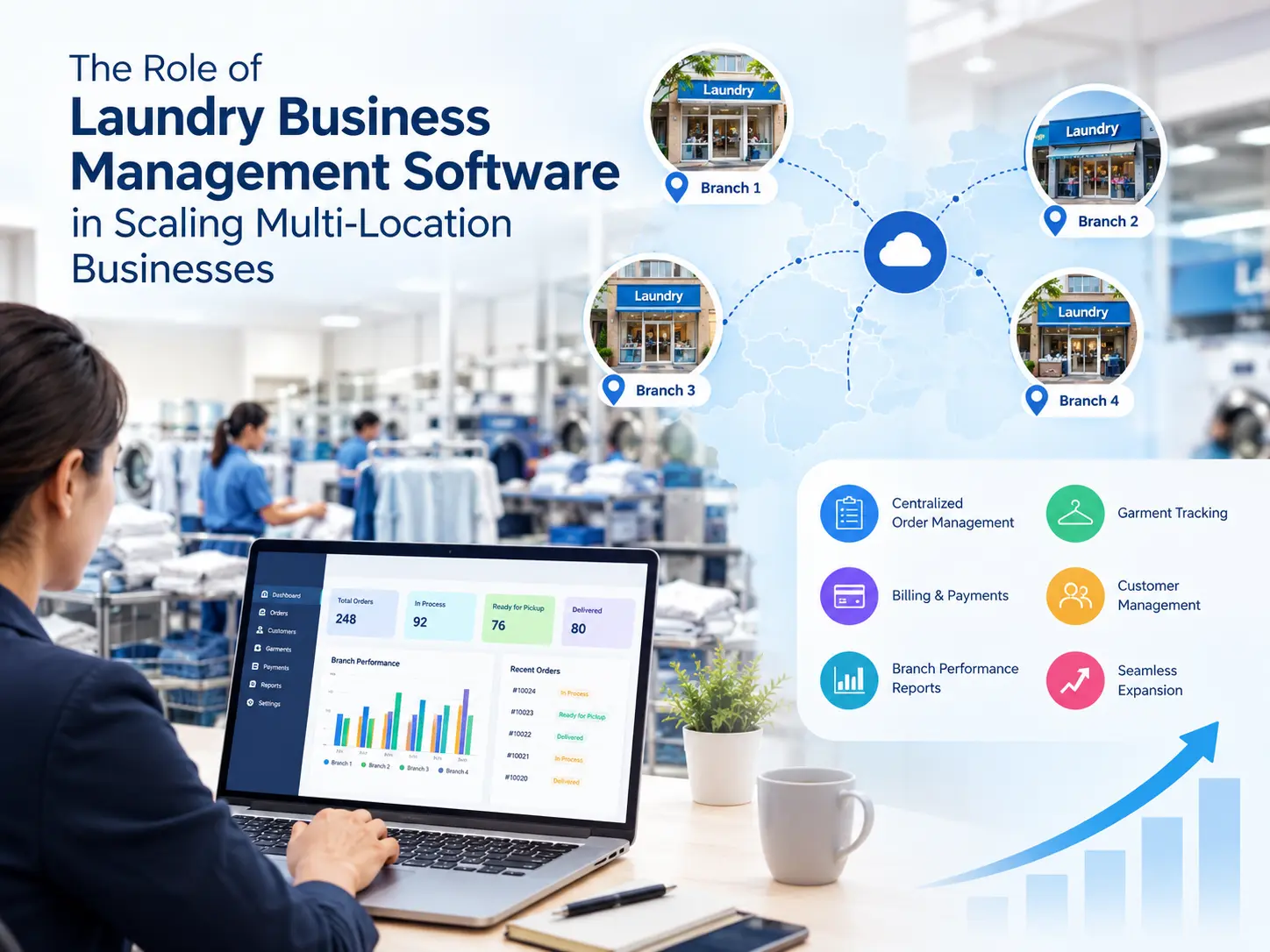
Expanding a laundry business across multiple locations creates new opportunities for revenue, customer acquisition, and brand growth. However, managing several branches also introduces operational challenges, including inconsistent service quality, order tracking difficulties, billing errors, and limited visibility into branch performance. Without a centralized approach, business owners may struggle to maintain efficiency as their operations expand.
Laundry business management software helps address these challenges by bringing essential business activities into one digital platform. From managing customer orders and monitoring garment status to tracking payments and reviewing branch performance, the right technology can help laundry businesses build a more scalable operating model.
When a laundry business operates from a single location, employees can often coordinate orders, deliveries, and customer requests through direct communication. As the business expands, this approach becomes harder to maintain.
Each branch may develop different procedures for accepting orders, processing garments, handling customer complaints, and recording payments. These differences can affect service quality and make it difficult for management to understand overall business performance.
A centralized laundry management system helps standardize these activities across branches. Business owners can establish consistent workflows, monitor daily operations, and maintain better control over business information without relying entirely on manual reports.
This structure also supports expansion because new branches can follow established processes instead of developing separate systems from scratch.
Managing customer orders consistently is one of the most important requirements for a growing laundry business. When branches use separate registers, spreadsheets, or disconnected applications, locating order details and checking garment status can become time-consuming.
Laundry software helps organize customer orders in a centralized digital environment. Depending on the platform, employees can record order details, update processing stages, review delivery schedules, and retrieve customer information more efficiently.
For multi-location businesses, centralized order management can help owners gain better visibility into activity across branches. It also reduces the need to communicate repeatedly with individual locations to obtain routine order updates.
For example, if a customer contacts the main office about an order submitted at another branch, authorized staff may be able to retrieve the relevant information without asking employees to search through paper records.
Customers expect a consistent experience regardless of which branch they visit. Differences in pricing, order handling, delivery communication, and complaint resolution can weaken customer trust.
A digital management platform helps businesses create standardized procedures for common activities. Depending on available features, these may include order registration, service selection, garment tracking, billing, and customer notifications.
A consistent workflow also makes employee training easier. New staff can learn established processes instead of relying exclusively on informal instructions from experienced colleagues.
Standardization becomes particularly valuable when opening new branches or managing franchise locations. Business owners can introduce common operating procedures while allowing individual locations to handle their local requirements.
Garment tracking becomes more complicated as order volumes increase across multiple locations. Without a reliable tracking process, employees may spend considerable time locating items, checking processing stages, or investigating delayed orders.
Modern laundry service software can support garment identification, order-status updates, barcode scanning, and processing workflows, depending on the system selected.
These capabilities help employees understand which orders have been received, are being processed, are ready for collection, or require further attention.
Better visibility can also help managers identify recurring bottlenecks. For instance, if one branch regularly experiences delays during finishing or packaging, management can investigate staffing, equipment capacity, or workflow issues.
The result is a more organized process that supports timely service as the business grows.
Financial management becomes more demanding when a business operates several branches. Separate billing practices, inconsistent records, and delayed reporting can make it difficult to understand revenue and outstanding payments.
A centralized laundry management system can help organize invoices, record payments, maintain transaction histories, and generate financial reports. Depending on the platform, businesses may also be able to support digital payments and automated billing workflows.
Standardized billing processes help reduce avoidable inconsistencies between locations. They also make it easier for management to compare branch performance using consistent reporting methods.
For example, owners can review sales activity, payment collections, and outstanding balances across branches to identify areas that require attention.
However, businesses should confirm whether their chosen software supports consolidated reporting, branch-level permissions, and the accounting integrations they need.
Customer information is an important asset for a growing laundry brand. When each branch maintains separate records, staff may have difficulty accessing service preferences, order histories, and customer communication details.
With suitable centralized customer management features, authorized employees can access relevant customer records across locations. This can support more personalized service and reduce repetitive information collection.
Businesses can also use customer histories to understand ordering patterns, identify frequent customers, and develop appropriate loyalty initiatives.
For example, a customer who regularly uses wash-and-fold services may appreciate convenient repeat ordering or relevant service updates. Centralized records make it easier to deliver a consistent experience across participating branches.
Businesses should also establish appropriate access controls and protect customer information in accordance with applicable privacy requirements.
Expansion decisions should be based on reliable business information rather than assumptions alone. Multi-location operators need to understand which branches are performing well, where costs are increasing, and which services generate demand.
Laundry business management software with reporting and analytics capabilities can help managers review indicators such as:
Daily and monthly order volumes
Revenue by branch
Average order value
Pending and completed orders
Delivery performance
Customer retention patterns
Outstanding payments
These insights can help management identify operational weaknesses and allocate resources more effectively.
For example, a branch with increasing order volumes but frequent delivery delays may need additional staff, improved equipment utilization, or revised scheduling. Another location with lower sales may benefit from local marketing or service improvements.
The usefulness of these insights depends on accurate data entry and the quality of the software's reporting features.
Opening additional branches should not require business owners to multiply administrative work at the same rate as their physical locations.
A scalable digital platform helps establish repeatable workflows for order handling, customer service, billing, and reporting. Once these processes are configured, they can often be extended to new locations with fewer manual steps.
The right laundry software can also help management identify which processes should be standardized and which require branch-specific flexibility.
Before selecting a solution, businesses should evaluate its ability to accommodate additional users, branches, order volumes, and integrations. They should also review pricing structures to understand how software costs may change as the business expands.
Scalability is not simply about supporting more locations. It is about maintaining control, visibility, and service quality as operational complexity increases.
Not every software platform is designed for multi-branch operations. Before making a decision, business owners should assess their current requirements and long-term expansion plans.
Important features to evaluate include:
Centralized order management: The ability to manage orders and review their status across locations.
Branch-level reporting: Reports that help compare revenue, order volumes, and operational performance.
Garment tracking: Tools such as barcode identification and status updates, where required.
Customer management: Shared customer records with appropriate access permissions.
Billing and payments: Consistent invoicing, payment recording, and financial reporting.
User access controls: Permissions that allow employees to access the information required for their roles.
Scalability and support: The ability to add branches, users, and workflows as the business grows.
Businesses should also evaluate implementation costs, staff training requirements, customer support, data security, and migration from existing systems. A trial or product demonstration can help confirm whether the software fits actual day-to-day operations.
Scaling a multi-location laundry business requires more than opening new branches. It requires consistent processes, reliable operational information, efficient customer service, and the ability to monitor performance across every location.
A well-chosen laundry management system can help bring these activities together, reduce dependence on manual processes, and give business owners greater visibility into daily operations. By combining centralized order management, garment tracking, billing, customer records, and reporting, businesses can create a stronger foundation for sustainable growth.
Choosing technology that matches current needs and future expansion plans can make multi-branch management more organized and easier to scale.
Explore BilloraOne Dry Cleaning Software to discover how digital tools can help organize laundry operations, improve order visibility, and support business growth. Evaluate the available features to determine whether they fit your multi-location requirements.
Contact us today to learn more about solutions for streamlining your laundry business operations.



Share this page with your family and friends.