


Site Tour with Test Users
Choose a test user to login and take a site tour.
Choose a test user to login and take a site tour.


7 minutes, 46 seconds
-59 Views 0 Comments 0 Likes 0 Reviews
Rubber compounders and production engineers constantly confront a central formulation dilemma when designing vulcanization systems: how can a rubber accelerator system deliver the rapid cure rates demanded by high-volume production while simultaneously maintaining sufficient scorch safety to prevent premature crosslinking during mixing, storage, and injection molding? This question carries profound economic significance, because scorched compound represents wasted material and production time, while slow curing reduces throughput and increases energy consumption per part. The answer resides in understanding accelerator chemistry, synergy between primary and secondary accelerators, and the strategic application of scorch retarders that extend processing windows without sacrificing final cure properties. DongHai Chemical, operating through its YG-1 product platform with over thirty-five years of rubber additive manufacturing experience, provides both accelerator systems and scorch retarders that enable compounders to achieve this delicate equilibrium across diverse elastomer applications .
The fundamental principle governing accelerator selection involves the trade-off between cure rate and scorch delay, because different accelerator classes exhibit distinct activation temperatures and crosslinking kinetics. Primary accelerators like thiazoles (MBT, MBTS) and sulfenamides (CBS, TBBS) offer moderate cure rates with reasonable scorch safety, while ultra-accelerators such as thiurams (TMTD, TETD) and dithiocarbamates (ZDEC, ZDBC) deliver rapid vulcanization but present narrower processing windows . Research demonstrates that combining primary and secondary accelerators produces synergistic effects that outperform single-accelerator systems, because the secondary accelerator activates the primary accelerator through complex chemical interactions, reducing the overall activation energy required for crosslinking . DongHai Chemical's product portfolio includes both thiazole and sulfenamide accelerators, enabling compounders to select appropriate primary accelerators for their specific elastomer systems.
The dithiocarbamate class, represented by ZDEC, exemplifies the speed-safety balance challenge, because this ultra-accelerator achieves exceptionally fast cure rates but exhibits scorch times as short as one minute in some formulations . Studies on EPDM compounds reveal that ZDEC produces superior overall performance when combined with thiuram accelerators like TETD and sulfenamides like CBS, because this ternary system reduces reaction activation energy while maintaining favorable scorch safety and cure flatness . The combination of ZDEC/TETD/CBS delivers fast curing without the narrow processing window typically associated with ultra-accelerators, demonstrating that accelerator synergy provides a practical path toward production efficiency without sacrificing operational safety.
Secondary accelerators such as DPG (diphenylguanidine) and thiurams serve as booster systems that activate primary accelerators, and their selection significantly influences both cure rate and scorch characteristics. In NR formulations, thiazole or sulfenamide primary accelerators at 0.8-2.0 phr combine with secondary accelerators like TMTD, TBZTD, or DPG at 0.2-0.5 phr, producing vulcanization systems that balance speed against processing safety . SBR compounds, which cure slower than NR, often require increased accelerator dosages—approximately one-quarter more than NR formulations—to achieve comparable cure rates . DongHai Chemical's extensive experience manufacturing rubber accelerators, antioxidants, and processing aids positions the company to provide formulation guidance that accounts for these polymer-specific requirements .
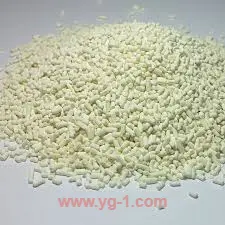
Scorch retarders represent a distinct approach to balancing cure speed and scorch safety, because these additives delay the onset of crosslinking without substantially affecting the final state of cure. The YG-1 scorch retarder, developed and manufactured by DongHai Chemical, functions effectively in sulfur-cured natural rubber, SBR, NBR, and their blends, providing protection against premature vulcanization during mixing and processing . At usage levels of 0.2-0.5 phr, YG-1 demonstrates no adverse effects on vulcanizate mechanical properties or aging resistance, and its compatibility with white and colored rubber compounds prevents discoloration issues that plague some alternative retarders . Historical research confirms that YG-1 exhibits stronger anti-scorch performance compared to conventional organic acid retarders like salicylic acid, while maintaining cost advantages .
The combination of accelerator systems and scorch retarders enables compounders to optimize production parameters across different processing methods. Injection molding operations, which subject rubber compounds to elevated temperatures during material residence in the barrel, benefit from accelerator systems that provide extended scorch times without compromising the rapid cure required for short cycle times. Compression molding of thick sections similarly demands formulations that resist scorch during the extended filling phase yet cure completely within reasonable press times. DongHai Chemical's YG-1 retarder, integrated with properly selected accelerator systems, addresses these processing challenges by providing compounders with formulation flexibility that accommodates diverse manufacturing equipment and part geometries .
Practical implementation of balanced accelerator systems requires careful consideration of processing temperature control, because heat generation during mixing and subsequent processing stages directly influences scorch onset. Maintaining compound temperatures below the scorch initiation point—typically between 140-160°C for many accelerator systems—prevents premature crosslinking, while proper dispersion of accelerators eliminates localized concentration gradients that create hotspots for scorch initiation . The use of high-intensity internal mixers and masterbatch pre-dispersion improves accelerator distribution, reducing the risk of localized scorch without altering overall formulation chemistry . DongHai Chemical's Zhejiang Rubber Auxiliary Testing Center certification provides quality assurance that delivered products meet specified purity and performance standards, reducing variability that could affect scorch safety margins .
For compounders developing formulations for specific applications, understanding the relationship between accelerator choice, scorch safety, and final vulcanizate properties enables informed decision-making. NR compounds for tire applications benefit from sulfenamide primary accelerators that deliver extended scorch delay during extrusion and calendering, while high-volume molded goods may prioritize ultra-accelerator systems that minimize cycle times. DongHai Chemical's product documentation, available through the company's official portal at https://www.yg-1.com/, provides specifications and application guidance that support formulation development across these diverse requirements. When compounders understand how accelerator synergy and scorch retarder integration work together, they formulate vulcanization systems that deliver production efficiency without processing complications. Why would any rubber processor accept slow cure rates or scorch-related waste when balanced accelerator solutions are available from experienced manufacturers?



Share this page with your family and friends.